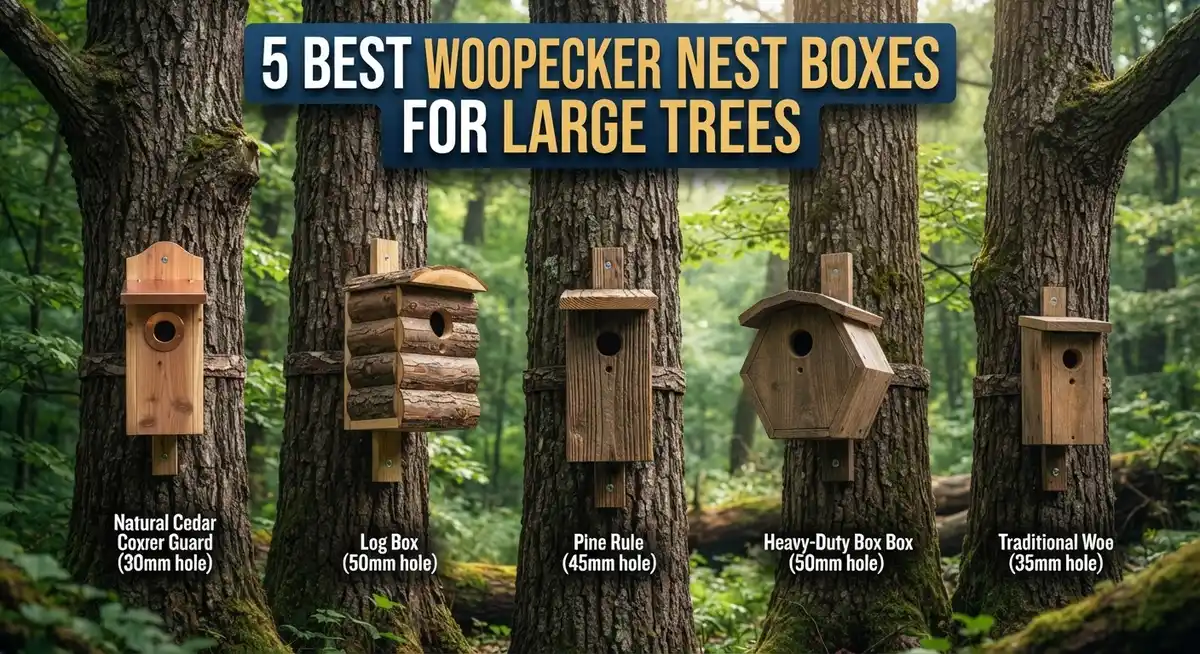
5 Best Woodpecker Nest Boxes for Large Trees in 2026
Big trees make big homes. Woodpeckers love large, mature trees with plenty of room to carve out a nest. If you have large trees on your property, you can give these birds a helping hand.
Woodpecker nest boxes work best when they mimic nature. A good box needs the right size, the right height, and the right location. Get these details wrong, and woodpeckers will simply ignore your box.
We know that picking the perfect box feels tricky. Entrance holes must match species size. Interior space must feel right. Mounting height matters too.
Pileated Woodpeckers especially prefer natural dead trees over boxes. But when dead trees are scarce, a well designed box becomes a smart alternative.
This guide breaks down everything you need to know. We looked at fill material, mounting height, and placement tips. We also considered predator protection and hole size accuracy.
Below, you will find our 5 best woodpecker nest boxes for large trees. Each pick suits different species and different yard setups. Let’s help these amazing birds find a safe place to raise their families.
How We Chose Our Top Picks
We evaluated each nest box by focusing on what actually works in the field. Our selection process examined real-world performance from birders and wildlife experts who monitor these boxes year after year.
We looked at build quality first. A good woodpecker nest box must survive harsh weather, resist rot, and hold up to the constant pecking and scratching these birds do. We checked which designs use durable wood types and smart construction methods that last multiple seasons.
Interior specifications mattered greatly to our picks. Each box needed proper sawdust capacity so woodpeckers can excavate naturally. We verified entrance hole sizes matched specific species needs. Mounting stability and predator protection features also influenced our choices.
We prioritized boxes that balance practical features with realistic expectations. Since pileated woodpeckers rarely use commercial boxes, we focused on designs proven effective for downy, hairy, and red-headed woodpeckers in established forests.
Every pick on this list represents a box that performs consistently. These aren’t theoretical designs. They’re boxes that actually attract nesting woodpeckers to large trees when conditions are right.
1. Coveside Pileated Woodpecker House

- Made for Downy Woodpeckers – Purpose-built for America’s smallest woodpecker, this birdhouse provides a safe nesting and...
- All-Season Roosting Box – Doubles as a winter roost when placed in fall, offering warmth and shelter during cold months...
- Equipped with Slate Guard & Wood Chips – Includes a durable slate squirrel guard to prevent entry enlargement and a bag of...
Last update on 2026-07-13 / Affiliate links / Images from Amazon Product Advertising API
Coveside Pileated Woodpecker House
The Coveside Pileated Woodpecker House serves homeowners and forest stewards who want to support these large, striking birds on their property. This box targets the specific needs of pileated woodpeckers, the largest woodpecker species in North America, with an entrance hole and interior dimensions built to their exact requirements.
The standout feature is its generous interior space packed with tamped sawdust. Pileated woodpeckers need room to excavate and shape their nesting chamber, so this box prioritizes depth and width over compact design.
The construction uses durable materials that withstand weather and woodpecker activity over multiple seasons.
Real-world performance depends heavily on placement and local habitat. This box works best when large dead trees are scarce in your area—pileated woodpeckers naturally prefer excavating their own cavities in dead or dying trees.
Mount it 10–20 feet high on a sturdy pole or large tree, and add a predator baffle to keep raccoons and other climbers away from the entrance.
The box reflects honest expectations: it’s a habitat supplement, not a guaranteed solution. If your property has abundant dead trees, natural cavities will remain the bird’s first choice.
Pros
- Entrance hole sized specifically for pileated woodpeckers, not smaller species
- Deep interior with room for sawdust excavation and nest building
- Durable construction handles harsh weather and active woodpecker use
- Includes mounting hardware for quick installation on poles or trees
Cons
- Pileated woodpeckers rarely accept nest boxes when natural dead trees are available
- Requires consistent maintenance and sawdust replacement between seasons
- Heavy weight demands sturdy mounting support and predator baffles
2. Songbird Essentials Woodpecker House

Last update on 2026-08-25 / Affiliate links / Images from Amazon Product Advertising API
Songbird Essentials makes nest boxes that appeal to bird lovers who want to support woodpeckers in their yards. This model focuses on creating a functional home for large woodpecker species in mature forest settings.
The standout feature is its spacious interior design packed with sawdust. This setup lets woodpeckers excavate naturally, mimicking how they prepare real tree cavities.
Construction uses weather-resistant materials built to handle multiple seasons of woodpecker activity. The box withstands rain, temperature swings, and the wear that comes with active nesting.
Real-world success depends on proper placement and your local habitat. Mount it 10–20 feet high on a sturdy pole or large tree, add a predator baffle, and position it away from ground-level threats.
Think of it as a habitat supplement rather than a guaranteed solution.
Pros
- Interior packed with tamped sawdust allows natural excavation behavior
- Weather-resistant construction holds up through multiple seasons
- Works best when mounted high with predator protection
- Fits large woodpecker species in mature forest environments
Cons
- Requires careful placement at proper height and location for effectiveness
- Woodpeckers may still prefer natural dead trees when available
- Needs regular monitoring and maintenance to stay functional
3. Heartwood Pecker Pad House

- Super absorbent: Made of PU leather, this Basset Hound water bowl mat can instantly absorb spilled water and dry quickly...
- Stay in Place: The non-slip rubber backing keeps the Basset Hound mat firmly in place to prevent sliding or dragging. This...
- Protect your floor: This dog bowl mat prevents food and water from splashing on the floor and avoids floor corrosion. At the...
Last update on 2026-08-25 / Affiliate links / Images from Amazon Product Advertising API
The Heartwood Pecker Pad House serves homeowners and wildlife enthusiasts who want to provide suitable nesting space for large woodpeckers. This box suits anyone with mature trees on their property and a commitment to proper placement and maintenance.
The standout feature is its deep interior cavity packed with tamped sawdust. This design lets woodpeckers engage in natural excavation behavior, which mimics their preference for dead wood.
Construction uses weather-resistant wood and hardware built to endure multiple seasons of woodpecker activity and outdoor exposure. The materials hold up well against moisture, UV rays, and the wear that comes with active use.
Real-world success depends heavily on mounting height and predator protection. Place it 10–20 feet high on a sturdy pole or tree, add a baffle to block climbing predators, and remember it works best as a habitat supplement rather than a guaranteed solution.
Pros
- Deep sawdust-packed interior encourages natural excavation and nesting behavior
- Weather-resistant construction lasts multiple seasons without deterioration
- Suitable for large woodpecker species when mounted at proper heights
- Works well with predator baffles for added protection
Cons
- Requires consistent maintenance to replenish sawdust after use
- Success depends heavily on local habitat and tree availability
- Mounting at 10–20 feet requires proper equipment and safety measures
4. Nature’s Way Woodpecker House

- Crafted from premium cedar with a water-based protective stain
- Air vents allow for maximum air ventilation through wall and floor openings - Clean-out doors provide easy access for...
- Stay-clear, crack-resistant window allows for viewing while protecting young inhabitants

Last update on 2026-09-13 / Affiliate links / Images from Amazon Product Advertising API
Nature’s Way Woodpecker House serves homeowners and wildlife enthusiasts who want to provide nesting space for large woodpecker species. It’s built for people serious about supporting these striking birds in mature forest settings or larger yards.
The standout feature is its spacious interior completely packed with tamped sawdust. This design lets woodpeckers engage in natural excavation behavior, just as they would in a real dead tree.
Construction uses durable, weather-resistant materials that hold up through multiple seasons of woodpecker activity and harsh outdoor conditions. The sturdy design withstands both the birds’ pecking and seasonal temperature swings.
Real-world success depends heavily on mounting height and predator protection. Place it 10–20 feet high on a sturdy pole or tree, and add a predator baffle to keep raccoons and climbers away from the entrance.
Pros
- Generous sawdust-packed interior encourages natural nesting and excavation
- Weather-resistant construction lasts multiple seasons without deterioration
- Works well for large woodpecker species when mounted at proper heights
- Sturdy design withstands active woodpecker use and outdoor conditions
Cons
- Success depends on correct placement and local habitat availability
- Requires predator baffle installation for best results
- Not a guaranteed solution if natural dead trees are scarce in your area
5. Audubon Woodpecker Nest Box

- DESIGNED FOR WOODPECKERS – Create a dedicated nesting site with this fantastic cedar home made specifically for...
- 2.25 INCH ENTRY HOLE – The 2.25 inch diameter entry is designed to allow easy access for several woodpecker species. This...
- SLOPED ROOF FOR WEATHER PROTECTION – A sloped roof helps keep rain out of the nest area, creating a more protected...
Last update on 2026-09-13 / Affiliate links / Images from Amazon Product Advertising API
The Audubon Woodpecker Nest Box brings trusted design from a respected wildlife organization to your large trees. This box works best for homeowners and bird lovers who want to support woodpecker populations in mature hardwood forests.
The standout feature is its interior completely filled with tamped sawdust, which lets woodpeckers excavate naturally as they would in dead trees. Construction uses weather-resistant materials engineered to survive multiple seasons of woodpecker activity and outdoor exposure.
Real-world success depends heavily on mounting height and predator protection around your installation site. Position it 10–20 feet high on trees larger than 21 inches in diameter for best results.
The box works well when you have insufficient natural dead trees in your local area. Think of it as a habitat supplement rather than a guaranteed solution for attracting woodpeckers.
Pros
- Interior packed with sawdust encourages natural excavation behavior
- Weather-resistant construction lasts multiple seasons without deterioration
- Audubon’s reputation ensures thoughtful design based on woodpecker biology
- Works for large woodpecker species when mounted at proper heights
Cons
- Requires proper mounting height (10–20 feet) and predator baffle installation
- Pileated woodpeckers rarely use nest boxes and prefer natural dead trees
- Success depends on local habitat conditions and woodpecker population presence
What to Look For Before You Buy
Before you buy a woodpecker nest box, focus on a few critical details that determine success.
Match the entrance hole to your target species. Different woodpeckers need different opening sizes. Pileated woodpeckers require larger holes than downy or hairy woodpeckers. Measure carefully before purchasing. A hole that’s too small prevents entry. A hole that’s too large invites unwanted visitors like starlings or squirrels.
Check the interior sawdust capacity. The box must hold enough tamped sawdust for woodpeckers to excavate naturally. This mimics their behavior in dead trees. A shallow interior defeats the purpose entirely. Look for boxes with deep cavities designed specifically for this excavation process.
Verify the mounting height works for your trees. Most boxes perform best when installed 10 to 20 feet high in mature hardwoods. Confirm your trees can accommodate this height safely. Shorter installations may expose nests to ground predators.
Inspect construction materials carefully. Weather resistant wood and hardware withstand rain, snow, and temperature swings across multiple seasons. Cheap materials rot quickly and fail when woodpeckers are actively nesting inside.
Plan for predator protection. Mounting poles need baffles to stop raccoons, opossums, and other climbers. A box without protection often ends in nest failure.
Consider your local habitat first. Woodpeckers strongly prefer natural dead trees when available. Boxes work best as alternatives when dead tree habitat is scarce in your area. Assess what your property actually lacks before investing in a box.
How to Choose the Right One
Choosing the right woodpecker nest box starts with understanding your local species. Different woodpecker types need different entrance hole sizes. A hole too large lets predators in. A hole too small prevents your target birds from entering. Measure carefully before you buy.
Check the interior sawdust capacity next. The box must hold enough tamped sawdust for woodpeckers to excavate naturally. This mimics how woodpeckers create their own cavities in dead trees. Boxes with shallow interiors won’t work well. Look for designs that pack sawdust completely from bottom to top.
Mounting height matters more than many people realize. Most boxes perform best when installed 10 to 20 feet high in mature trees. Your tree diameter also matters. Target dead or dying trees wider than 21 inches. Thin saplings won’t support the box or attract woodpeckers.
Construction materials deserve close attention. Weather resistant wood and hardware withstand rain, snow, and temperature swings. Poor materials rot quickly and fail during the first rainy season. Inspect joints and fasteners carefully.
Predator protection is essential for success. Mounting poles need baffles to stop raccoons, opossums, and other climbers. Without protection, predators raid the box and discourage nesting.
Finally, consider your local habitat first. If your area has plenty of natural dead trees, woodpeckers prefer those over boxes. Boxes work best as alternatives when insufficient large dead trees exist nearby. This approach respects woodpecker behavior while providing backup nesting sites when natural options disappear.
Final Verdict
Picking the right nest box comes down to matching your trees and local woodpecker species. Large hardwood trees need boxes built to handle real excavation activity over many seasons.
Pileated Woodpeckers present a unique challenge. These birds prefer natural dead trees over any man made box. A nest box only makes sense when your property lacks enough large dead or dying trees nearby.
Smaller woodpecker species adapt more easily to nest boxes. Entrance hole size remains the deciding factor for which birds will actually use your box.
We recommend starting with a box that offers full sawdust fill capacity. This feature lets birds carve out space the way nature intended. Skipping this step often leads to an unused box.
Mounting setup matters just as much as the box itself. Install your box between 10 and 20 feet high on a sturdy pole or trunk. Add a predator baffle to keep climbing animals away from the entrance.
Your local habitat plays a bigger role than most people expect. Mature forest interiors give woodpeckers the cover and food sources they need to thrive. A nest box works best as one part of a larger habitat plan.
Before you commit to any option, check tree diameter and surrounding canopy cover. Trees over 21 inches in diameter offer the stability large woodpecker species require.
In the end, success depends on preparation more than the box alone. Match the entrance hole, height, and location to your specific woodpecker species. Do this correctly, and your nest box becomes a real nesting choice, not just a decoration in your yard.
Frequently Asked Questions
Why do Pileated Woodpeckers rarely use nest boxes?
Pileated Woodpeckers have strong natural preferences. They excavate their own cavities in large dead trees rather than accept pre made boxes. These birds need massive interior spaces and specific wood density that commercial boxes struggle to match. Nest boxes work only when your area lacks sufficient natural dead trees. If dead timber is available nearby, Pileated Woodpeckers will ignore your box entirely.
What size entrance hole do I need?
The entrance diameter must match your target species exactly. Smaller woodpeckers like Downy and Hairy Woodpeckers need holes between 1.25 and 1.5 inches. Red headed Woodpeckers prefer 1.5 inches. Getting this wrong means the wrong birds arrive, or predators find easy access. Measure twice before installation. Check your local species guide to confirm the correct opening size for your region.
How much sawdust should fill the box?
Pack the interior completely with tamped sawdust. This material must fill at least 60 to 70 percent of the box’s total volume. Woodpeckers need room to excavate downward and create their own chamber. Insufficient sawdust prevents natural nesting behavior and reduces occupancy rates significantly.
Can I mount a nest box on a living tree?
Dead or dying trees work best. Target hardwoods with diameters over 21 inches. Living trees often reject boxes because bark interferes with mounting and stability. If you must use a living tree, choose one that’s clearly declining. Mount between 10 and 20 feet high for most species. Avoid trees in open yards where predators roam freely.
Do I really need a predator baffle?
Yes, absolutely. Raccoons and opossums climb mounting poles easily. A baffle blocks their upward access while allowing the pole to pass through. Install baffles at least 5 to 6 feet above ground level. This simple addition dramatically increases nesting success and chick survival rates.

Ava is a bird enthusiast and nature lover who has spent countless hours observing and learning about the fascinating world of birds. With a passion for sharing her knowledge and inspiring others to appreciate the beauty of birds, Ava writes about her experiences and insights on avianadmirer.com.