
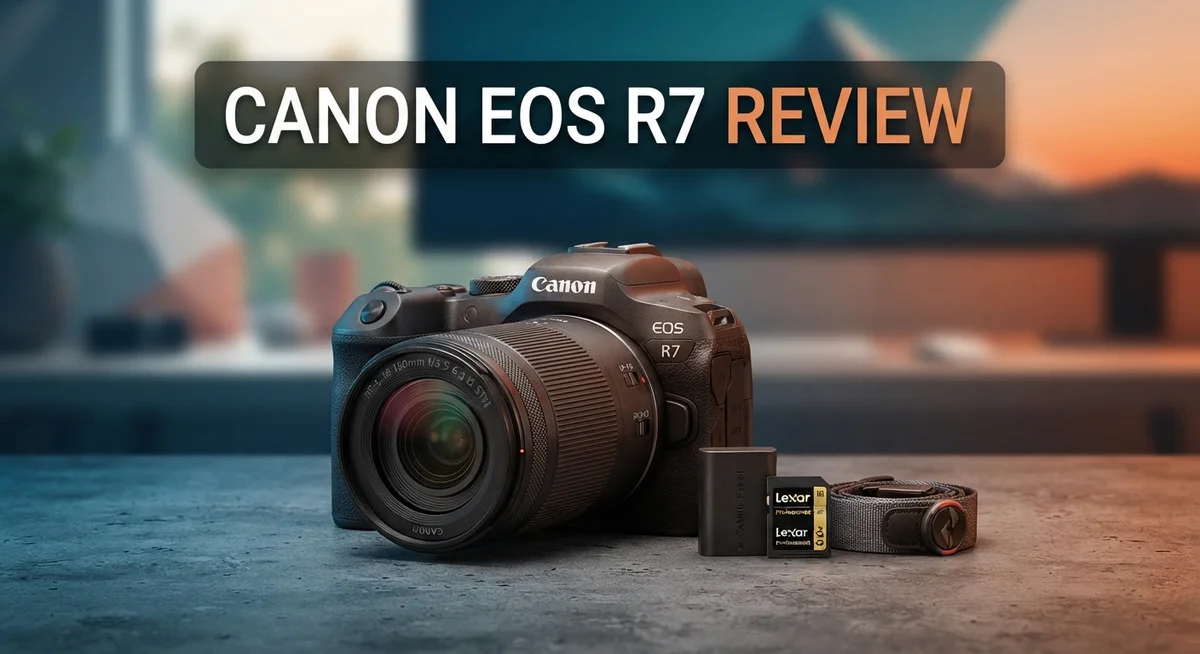
Canon EOS R7 Review: Mirrorless Camera Worth Trying?
The Canon EOS R7 packs serious power into a small body. It brings a 32.5MP APS-C sensor to Canon’s RF mount lineup. Photographers get pro level detail without carrying a heavy camera.
This camera stands out for its speed. Fast autofocus locks onto subjects with ease. Wildlife and sports shooters will notice the difference right away.
Canon added 5-axis image stabilization inside the body. This means sharper handheld shots even in tricky light. Your videos and photos both benefit from steadier results.
The fully articulated LCD screen adds flexibility. Vloggers and casual shooters can frame shots from any angle. It folds out and rotates to match your creative needs.
Weather resistance makes this camera tough. Dust and light rain will not slow you down. That durability matters for outdoor photographers who shoot in changing conditions.
Of course, no camera is perfect. The R7 has some quirks in low light and video quality. We will cover these honestly in this review.
Stick around to see if this camera fits your style. We will break down every feature that matters to real photographers.
In a Nutshell
Here is the quick summary of what this camera brings to the table.
-
Sensor power: The 32.5MP APS-C sensor captures sharp, detailed images. Photos hold up well even when you crop in close.
-
Autofocus that works: Canon built fast, reliable autofocus into this camera. It locks onto subjects quickly during daylight shoots.
-
Built for RF lenses: The RF mount connects this camera to a growing lens lineup. This gives you room to expand your gear over time.
-
Storage flexibility: Dual card slots let you back up files instantly. Professionals will appreciate this safety net during shoots.
-
Self cleaning sensor: Built in sensor cleaning keeps dust away from your shots. You spend less time editing out spots and specks.
-
Low light struggles: Video quality drops a bit in dim settings. Some users notice soft focus or pixelation during night shoots.
-
Strong competition nearby: Cameras like the Sony a6700 and Fujifilm X-T5 offer similar features. Still, the R7 holds its own against these rivals.
This camera suits photographers who value speed and detail. Keep reading to see how it performs in real world testing.
Sensor and Image Quality
The 32.5MP APS-C CMOS sensor inside the R7 delivers sharp, detailed images across a wide range of lighting conditions. This sensor size strikes a smart balance between resolution and performance, giving you plenty of pixels to work with without creating massive file sizes.
Color science on the R7 feels natural and accurate. Skin tones look pleasing, and the camera handles reds and blues without oversaturating them. Canon’s color profiles give you flexibility in post-processing too, so you’re not locked into one look.
Dynamic range performance is solid. The sensor captures detail in both bright skies and shadowy foregrounds, which means less work fixing images later. You’ll notice this especially when shooting landscapes or mixed lighting scenes.
High ISO performance holds up well up to around 3200. Beyond that, grain becomes visible but remains acceptable for most uses. At 6400 and higher, you’ll want to apply noise reduction in editing software.
The 5-axis in-body image stabilization makes a real difference when shooting handheld. It lets you use slower shutter speeds without blur, which opens up creative options in low light. Video benefits from this too, though not as dramatically as stills.
One area where the R7 shows its limits is video in dim settings. The footage can appear pixelated or lack the smoothness you’d want for professional work. This isn’t a dealbreaker for casual video, but it’s worth knowing if video matters to you.
The sensor cleaning system removes dust automatically, keeping your images clean without manual intervention. This feature saves time and reduces the risk of spots in your shots.
Overall, the sensor and image quality combo makes the R7 a capable tool for photographers who value sharpness and color accuracy. The camera punches above its weight in most situations, though it shows minor weaknesses in extreme low light video work.

- CANON USA AUTHORIZED CAMERA KIT WITH ADDED BUNDLE ACCESSORIES: Includes Canon USA Protection. The Canon kit contains the EOS...
- 32.5MP APS-C DETAIL WITH ONE-LENS VERSATILITY: The high-resolution CMOS sensor and DIGIC X processor deliver detailed photos...
- HIGH-SPEED ACTION CAPTURE: Shoot at up to 15 fps with the mechanical shutter or up to 30 fps with the electronic shutter. RAW...
Last update on 2026-07-24 / Affiliate links / Images from Amazon Product Advertising API
Design and Build Quality
The Canon EOS R7 feels solid in your hands from the moment you pick it up. Canon engineered this camera with a compact frame that doesn’t sacrifice durability or comfort. The body uses a magnesium alloy chassis that resists bumps and wear during daily shooting.
The grip design fits most hand sizes well. Your fingers rest naturally on the shutter button and control dial. The textured rubber coating prevents slips even when your hands are wet or sweaty. Canon paid attention to how photographers actually hold cameras.
The fully articulated LCD screen is a standout feature. You can flip it forward, backward, and rotate it 180 degrees. This flexibility helps you shoot from awkward angles, film yourself, or work low to the ground without lying down. The screen itself displays colors accurately and responds quickly to touch input.
Weather resistance adds real peace of mind. Canon sealed the body against dust and water splashes. You won’t worry about sudden rain or dusty environments ruining your shots. This durability makes the R7 a genuine companion for outdoor adventures and professional work.
The dual card slots sit on the right side of the body. You can record to both simultaneously or use one as backup. This setup saves you from panic if one card fails during an important shoot. Accessing the slots requires removing the battery, which takes only seconds.
Button placement feels intuitive. The mode dial sits on top left. Function buttons cluster near your thumb. Canon avoided cramming controls into tight spaces. Even photographers with larger hands navigate menus and adjust settings without fumbling.
The built in sensor cleaning system works automatically. Vibrations shake dust off the sensor when you power on or off the camera. This means fewer dusty spots in your images and less need for manual cleaning. It’s a practical feature that extends time between professional sensor cleanings.
The overall build quality reflects Canon’s experience making professional gear. Nothing feels cheap or plasticky. This camera can handle years of regular use. The design balances portability with the robustness photographers demand for serious work.
Autofocus and Performance
The Canon EOS R7 uses a Dual Pixel CMOS AF system that locks onto subjects quickly and accurately. This autofocus setup performs well across the frame, even when you’re shooting at the edges of your composition.
The camera excels at tracking moving subjects. Whether you’re photographing birds in flight or athletes in motion, the AF system stays locked on target. Canon’s subject detection works smoothly for people, animals, and vehicles without requiring manual adjustments.
One area where performance dips is low light autofocus. The system can hunt for focus in dim conditions or struggle to lock onto soft subjects like faces when lighting is poor. This limitation matters most if you shoot indoors without supplemental lighting or during twilight hours.
Continuous autofocus during video recording performs decently in normal light. The camera tracks subjects smoothly without jarring focus shifts. However, the focus can become less reliable when you’re recording in challenging shadows or very dim environments.
The R7’s 5-axis stabilization helps compensate for camera shake during handheld shooting. You get approximately 5 stops of stabilization, which means you can shoot at slower shutter speeds without blur. This feature pairs well with the fast autofocus to keep your images sharp.
Burst shooting reaches up to 15 frames per second with continuous autofocus active. The buffer holds enough shots for most situations before write speeds slow down. This speed works well for action sequences and gives you multiple chances to capture the perfect moment.
Processing speed feels responsive throughout normal operation. Menu navigation is snappy, and the camera writes files to your dual card slots without long delays. Real world performance shows no lag when switching between shooting modes or adjusting settings.
The R7 handles most shooting scenarios with confidence. Fast autofocus in good light, solid stabilization, and quick burst shooting combine to make this camera reliable for diverse subjects. Low light autofocus remains the main performance weakness you should know about before committing to this system.
Top 3 Alternatives
Sony Alpha a6700

- SONY USA AUTHORIZED Includes Full SONY USA Warranty | Sony a6700 Mirrorless Alpha APS-C Camera - Next generation creativity...
- Consistently accurate exposure and color with new AE algorithm | Faster, more precise AF with 759 phase detection AF points...
- 5-axis in-body optical image stabilization with up to 5-steps of compensation | Precise anti-shake compensation at the...
Last update on 2026-07-24 / Affiliate links / Images from Amazon Product Advertising API
The Sony Alpha a6700 stands out as a powerful alternative for photographers who want fast autofocus and excellent video features. This camera uses a 26-megapixel sensor that captures sharp, detailed images in various lighting conditions. The real strength here is the autofocus system, which tracks moving subjects with impressive accuracy.
Video creators love this model because it shoots 4K footage at high frame rates. The compact body makes it easy to carry around for all-day shooting. Battery life is solid, and the camera handles both stills and video workflows smoothly.
Nikon Z6 III

- VIDEO - 6K/60p Internal N-RAW video recording + oversampled 4K UHD, 4K/120p, Full HD/240p slow motion, Hi-Res Zoom up to 2x...
- BEST IN CLASS EVF - Max brightness of 4000 nits gives a clear, vibrant view even in very bright conditions; 5760k-dot...
- WIDE ISO RANGE - ISO sensitivity range of 100-64000, with extended range up to Hi 1.7 (equivalent to ISO 204800).

Last update on 2026-07-24 / Affiliate links / Images from Amazon Product Advertising API
The Nikon Z6 III appeals to photographers seeking full-frame performance in a smaller package. With a 24-megapixel sensor, it produces clean images even at higher ISO settings. The autofocus performance is particularly strong for both photography and videography.
This camera excels in low-light situations, making it ideal for event photographers and content creators working indoors. The build quality feels premium, and the ergonomics are comfortable for extended shooting sessions. Nikon’s lens ecosystem offers plenty of options for different creative needs.
Fujifilm X-T5

- Unmatched Image Quality and Versatility: The FUJIFILM X-T5 Mirrorless Camera, equipped with a 40MP APS-C X-Trans CMOS 5 HR...
- Advanced Video Capabilities for Creators: Designed for multimedia creators, the X-T5 records up to 6.2K video at 30p in...
- Intelligent Autofocus and Image Stabilization: The X-T5 features a 425-point intelligent hybrid autofocus system, enhanced...
Last update on 2026-07-24 / Affiliate links / Images from Amazon Product Advertising API
The Fujifilm X-T5 brings unique color science and a retro design that appeals to photographers who enjoy hands-on controls. The 40-megapixel sensor delivers exceptional detail, perfect for large prints and detailed cropping. Film simulations offer creative color options straight out of the camera.
The X-T5 feels great to hold and use. Physical dials give you direct control over exposure settings without diving into menus. Weather sealing protects against dust and moisture during outdoor adventures. The camera produces beautiful JPEGs that need minimal editing.
Video Capabilities and Stabilization
The Canon EOS R7 brings solid video performance to a compact mirrorless package. The camera records 4K video at up to 60 frames per second, which handles most professional and personal projects well. You get 10 bit 4:2:2 internal recording options that give you more flexibility in post production editing.
The 5 axis in body stabilization system works during video capture too. This means handheld footage stays smooth even when you’re walking or panning across a scene. The stabilization kicks in automatically, so you don’t need to enable it separately. Smooth, shake free video becomes the default experience rather than something you have to work for.
One thing to know: video performance drops noticeably in low light situations. The sensor struggles to maintain clean footage when ambient light fades. You’ll see more noise and pixelation creeping into darker scenes. Shooting outdoors during daylight or with supplemental lighting produces much better results.
The autofocus system during video recording works decently in normal conditions. Continuous autofocus tracks moving subjects reasonably well when you have enough light. The camera uses the Dual Pixel CMOS AF system to keep focus locked, which performs better than older contrast detection methods.
The fully articulated LCD screen becomes valuable for video work. You can flip the screen toward you for selfie style recording or tilt it for overhead shots. This flexibility helps you frame shots from angles that would be impossible with a fixed rear screen.
Canon’s color science shines through in video footage. Colors appear natural and pleasing without heavy grading needed. The dynamic range holds up decently, though it won’t match higher end models in extreme lighting situations.
For content creators and filmmakers seeking a compact camera, the R7 delivers practical video capabilities. The stabilization, autofocus, and color rendering work together to produce professional looking content. Just remember to prioritize good lighting, and the camera rewards you with clean, sharp video output.
Handling and Ergonomics
The Canon EOS R7 feels solid in your hands from the moment you pick it up. The grip design fits most hand sizes well, and the compact body doesn’t sacrifice comfort during extended shooting sessions. Your fingers find the controls naturally without hunting around the camera body.
The button layout makes sense. Canon placed the most important controls where your thumb and fingers naturally rest. You won’t fumble when switching between shooting modes or adjusting settings on the fly. The menu system responds quickly, so navigating options feels smooth rather than frustrating.
The fully articulated LCD screen is a standout feature for handling. You can flip it out at any angle, making it easy to shoot from awkward positions. This flexibility helps when you’re shooting overhead, at ground level, or holding the camera at chest height. The screen becomes especially valuable when recording video or composing self portraits.
Weight distribution matters, and the R7 gets this right. The camera sits balanced in your grip without feeling top heavy or tail heavy. When you attach a lens, the whole package feels cohesive. The dual card slots sit on the right side of the body, so you can access them without removing the camera from your hand.
Weather resistance adds real peace of mind during outdoor work. You can shoot in light rain or dusty conditions without constant worry. The seals around buttons and compartments feel solid, not flimsy. The built in sensor cleaning system works automatically too, keeping your sensor free from dust without manual intervention.
The body materials feel professional without excessive weight. Canon chose finishes that resist fingerprints and minor scratches. Rubberized areas provide grip in wet conditions. Metal components underneath give the camera a premium feel that matches its performance.
Overall, the R7 handles like a camera designed by people who actually shoot. Nothing feels awkward or out of place. The compact size makes it travel friendly while maintaining the ergonomic quality you expect from Canon’s professional heritage.
Pros and Cons
The Canon EOS R7 delivers real strengths that appeal to many photographers. Its compact size makes it easy to carry for extended shooting sessions. The 32.5MP sensor captures excellent detail and color accuracy across various lighting conditions. Autofocus performance shines in daylight and normal indoor settings, locking onto subjects with impressive speed.
The weather resistant body gives you confidence shooting in rain or dusty environments. Dual card slots provide backup storage and workflow flexibility. The fully articulated screen opens creative possibilities for angles you couldn’t reach before. 5-axis stabilization keeps handheld footage smooth, whether you’re shooting stills or video.
Processing feels snappy throughout the menu system. Burst shooting at 15 frames per second handles action sequences well. The built-in sensor cleaning removes dust automatically, so you spend less time on maintenance.
However, some limitations exist worth considering. Low light autofocus struggles compared to full-frame competitors. The camera sometimes hunts for focus or delivers soft images in dim conditions. This matters if you shoot frequently in challenging light.
Video resolution maxes out at 4K, which lags behind some rivals in the mirrorless space. Video footage can appear pixelated in certain situations, particularly when pushing ISO higher. Low-light video performance dips noticeably, making evening shoots more difficult.
The autofocus system during video works decently in normal light but loses reliability as darkness increases. If you prioritize video work, you may want to explore other options that handle challenging conditions better.
The real story: The R7 excels as a stills camera with practical video abilities. It performs best in daylight and controlled environments. For photographers who shoot mostly daytime work or indoors with good lighting, this camera feels like the right choice. If low-light performance and advanced video features top your priority list, you’ll want to compare against competing models. The R7 offers genuine value for what it delivers, but understanding its boundaries helps you make an informed decision.
Who Should Buy It
The Canon EOS R7 works best for photographers who want a compact mirrorless camera without sacrificing image quality. If you shoot stills as your main focus, this camera delivers exactly what you need.
Wildlife and sports photographers find the R7 particularly useful. The 32.5MP sensor captures fine details. The 15 frames per second burst rate keeps pace with fast action. The autofocus system locks onto subjects quickly and reliably in good light conditions.
Travel photographers appreciate the compact design paired with weather resistance. You can shoot confidently in rain or dusty environments without worrying about your gear. The fully articulated LCD screen helps you frame shots from unusual angles. This matters when you’re exploring new locations and want creative perspectives.
Content creators benefit from the practical video capabilities. The 5 axis stabilization works during video recording. The color science produces pleasing footage in normal lighting. Just know that video performance drops in low light situations. If you need extensive 4K work, you might want to look at other options.
Photography students and hobbyists find the R7 strikes a good balance. The button layout makes sense. The menu system feels responsive. You can focus on learning photography instead of fighting your camera’s interface.
The R7 works less well if you demand cutting edge 4K video specs. The autofocus hunting in very dim conditions can frustrate you during video work. If you shoot primarily in low light, you should test this camera first.
Photographers switching from Canon DSLRs will feel at home immediately. The RF mount ecosystem keeps growing. The dual card slots provide backup security during important shoots.
Bottom line: Choose the R7 if you want a reliable, compact mirrorless camera that handles stills beautifully. The weather resistant body and articulated screen add real value to your workflow. You get professional image quality in a package that doesn’t weigh you down. This camera rewards photographers who know what they want and don’t need every cutting edge feature.
Final Verdict
The Canon EOS R7 earns its place as a smart choice for photographers. It combines a powerful sensor with fast autofocus and a body that feels great in hand.
This camera shines brightest for stills shooters. Wildlife photographers, sports shooters, and travel enthusiasts get a tool that keeps up with fast action.
The 32.5MP sensor captures fine detail. Combined with in-body stabilization, you get sharp images even in tricky handheld situations.
Video shooters should know what they are getting. The R7 handles casual video work well, but it is not built for filmmakers who need top tier 4K performance.
If low light video matters to you, weigh this limitation carefully. Autofocus can hunt when darkness increases, and footage may show some softness.
For everyone else, the R7 delivers where it counts. Weather resistance means you can shoot in rain or dust without worry. The articulated screen adds flexibility for different shooting angles.
Compared to competitors like the Sony a6700 or Fujifilm X-T5, the R7 holds its own. Each camera has strengths, but the R7 stands out for its balance of speed, build quality, and image quality.
Canon shooters switching from DSLRs will feel right at home. The learning curve is small, and familiar controls make the transition smooth.
Should you buy the Canon EOS R7? If you want a compact, capable camera for stills photography, the answer is yes. It handles wildlife, sports, travel, and everyday shooting with confidence.
If video is your main priority, look closely at what you need. The R7 covers basic video needs well but does not compete with cameras built specifically for advanced video work.
Overall, the Canon EOS R7 earns strong marks for photographers who want reliability, speed, and image quality in a compact mirrorless body. It fits a wide range of photography styles without demanding compromises in the areas that matter most.
Frequently Asked Questions
Is the Canon EOS R7 good for wildlife photography?
Yes, the R7 works excellently for wildlife. The 32.5MP sensor gives you sharp detail even when you crop images. Fast autofocus tracking keeps moving subjects in focus. The compact body makes it easy to carry long lenses into the field. Weather resistance protects your gear in unpredictable outdoor conditions.
Can you shoot video on the Canon EOS R7?
The R7 shoots 4K video, so you can record professional quality footage. The autofocus performs well in normal daylight. However, the system loses reliability once light drops. Video can appear pixelated in certain conditions. If video is your main focus, compare specs with dedicated video cameras first.
How does the R7 compare to the Sony a6700?
Both cameras use APS-C sensors and offer excellent image quality. The R7 feels more compact and lighter to carry. Sony’s a6700 has stronger 4K video capabilities. Canon’s menu system feels more intuitive to users switching from DSLRs. Choose based on your lens collection and workflow preference.
Who should buy the Canon EOS R7?
The R7 fits photographers who want stills excellence in a portable package. Travel photographers love the compact design. Content creators appreciate practical video features. Wildlife and sports shooters find it reliable and capable. Photography students benefit from the balance between features and simplicity. Skip it only if cutting edge 4K video specs are essential to you.
Does the R7 have image stabilization?
Yes. The camera includes 5-axis in-body stabilization. This helps you shoot handheld at slower shutter speeds. Stabilization works with any RF mount lens you attach. Combined with weather resistance, you get confidence in varied shooting situations.

Ava is a bird enthusiast and nature lover who has spent countless hours observing and learning about the fascinating world of birds. With a passion for sharing her knowledge and inspiring others to appreciate the beauty of birds, Ava writes about her experiences and insights on avianadmirer.com.

